
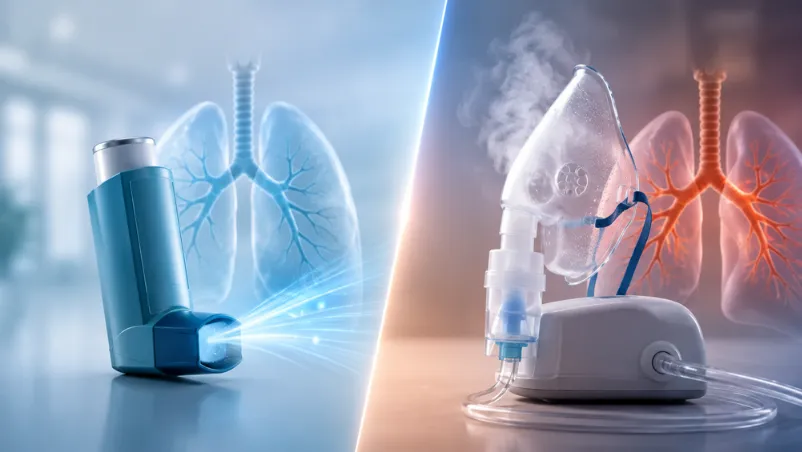
If you’ve ever stood in a pharmacy holding both an inhaler and a nebulizer kit, wondering which one will help you breathe easier faster, you’re asking a very reasonable question.
In most everyday situations, an inhaler works faster than a nebulizer, because it delivers medicine straight into your lungs in a single quick puff rather than over several minutes of misting.
For families searching for reliable asthma treatment in Secunderabad, knowing which device fits which situation can genuinely change how quickly symptoms are brought under control.
At Shenoy Hospitals, Secunderabad, our pulmonology team helps patients and parents choose and correctly use the right device for their specific needs.
Key Takeaways
- Inhalers usually act faster for mild to moderate breathing difficulty.
- Nebulizers can be more reliable during severe attacks or for those who can’t coordinate an inhaler puff.
- A spacer device can make an inhaler nearly as effective as a nebulizer.
- The right choice often depends on age, severity, and technique, not just speed.
- Some patients are prescribed both, for different situations.
Why Shenoy Hospitals
1963
Established Since 1963
Oldest nursing home
in Secunderabad
¼ Cost
corporate hospital bills
1L+
Babies Delivered
Successfully delivered
over 1 lakh babies
What Exactly Are Inhalers and Nebulizers Used For?
Both devices deliver medicine directly into the lungs to relax tight airways and ease breathing, but they do it in very different ways.
How Inhalers Work
An inhaler releases a measured puff of medicine, either as a pressurized spray (metered-dose inhaler) or a fine powder (dry powder inhaler), which you breathe in quickly and deeply.
How Nebulizers Work
A nebulizer turns liquid medicine into a fine mist using a small machine, which you breathe in continuously through a mouthpiece or mask over several minutes.
A setup and technique also detailed step-by-step byMedlinePlus, the U.S. National Library of Medicine.
What Causes the Breathing Difficulty They’re Both Treating?
These devices are most often used for asthma and COPD, both of which cause the airways to tighten, swell, or fill with mucus.
Two conditions that can look alike on the surface but behave very differently, as we’ve covered inhow doctors actually tell asthma and COPD apart.
Asthma-Related Triggers
Allergens, cold air, infections, or physical exertion can suddenly narrow the airways, leading to wheezing, coughing, and breathlessness.
COPD-Related Triggers
Long-term airway damage, often from smoking or prolonged pollution exposure, causes progressively narrowed airways that flare up further during infections or irritant exposure.
When Does a Flare-Up Become Serious Enough to Need One of These?
A flare-up needs immediate treatment when breathlessness interferes with talking, walking, or sleeping, not just when it’s mildly noticeable.
Mild to Moderate Symptoms
Occasional wheezing or slight breathlessness during activity is usually managed effectively with a quick-relief inhaler.
Signs of a Serious Attack
Seek urgent medical care if breathlessness is severe, lips or fingertips look bluish, speaking in full sentences becomes difficult, or symptoms don’t improve after using your prescribed device.
The same red flags worth knowing if you’ve ever wondered whetherchest tightness is coming from your heart or your lungs.
How Do Doctors Decide Which Device Suits a Patient?
Doctors consider age, hand-mouth coordination ability, severity of symptoms, and how well a patient responds to each device.
Coordination and Technique
Using an inhaler correctly requires timing your breath precisely with the puff, which can be genuinely difficult for young children, elderly patients, or anyone struggling to breathe during an attack.
Severity of the Episode
For severe flare-ups, doctors often prefer a nebulizer initially, since it doesn’t require perfect technique and can deliver medicine steadily over several minutes.
If you’re not sure whether your current device — or your child’s — actually fits how severe or frequent your symptoms are, that’s worth a proper look rather than guessing. Book an Appointment with our Department of Pulmonology at Shenoy Hospitals, Secunderabad, or Call Now.
Inhaler or Nebulizer — Which One Actually Works Faster?
For most mild to moderate symptoms, an inhaler works faster simply because the entire dose is delivered in seconds rather than minutes.
Why Speed Differs Between the Two
An inhaler pushes a full dose into your airways almost instantly, while a nebulizer requires five to ten minutes of steady breathing to complete a single treatment.
When a Nebulizer May Be More Effective
During a severe attack, when breathing is too shallow or rapid to use an inhaler properly, a nebulizer’s steady mist can deliver medication more reliably, even if it takes slightly longer overall.
The Role of a Spacer
Attaching a spacer (a holding chamber) to an inhaler slows down the spray and gives more time to inhale it fully, often closing much of the effectiveness gap with a nebulizer.
This is actually the same principle behind the bronchodilator step used during a pulmonary function test, where inhaled medication is timed carefully to measure how well your airways respond.
| Factor | Inhaler (with spacer) | Nebulizer |
| Speed of relief | Seconds to 1–2 minutes | 5–10 minutes |
| Technique needed | Moderate (easier with spacer) | Minimal |
| Best for | Mild-moderate symptoms, daily use | Severe attacks, young children, elderly |
| Portability | High | Low to moderate |
What Does Long-Term Use of Each Device Look Like?
Long-term use depends on whether the device is for daily prevention or occasional emergency relief.
Daily Maintenance Inhalers
Many patients use a maintenance inhaler daily to reduce airway inflammation over time, separate from the quick-relief inhaler used during symptoms.
Nebulizers for Ongoing Management
Some patients with more severe or difficult-to-control asthma or COPD use a nebulizer regularly at home, particularly if inhaler technique remains a consistent challenge.
How Does the Right Device Choice Affect Daily Life?
Choosing the right device reduces anxiety around flare-ups and helps patients feel more in control of their condition.
Confidence in Emergencies
Knowing your device works reliably, and having it readily accessible, reduces the panic that often accompanies sudden breathlessness.
Practical Routines for Families
Parents of children with asthma often keep both a spacer-fitted inhaler for school and a nebulizer at home for more severe episodes, giving flexibility across situations.
How Can You Reduce How Often You Need Either Device?
Reducing flare-up frequency comes down to consistent trigger avoidance and following your prescribed daily treatment plan.
Identifying and Avoiding Triggers
Tracking what precedes your flare-ups, whether it’s dust, cold air, or exertion, helps you plan around them more effectively.
Staying Consistent With Preventive Treatment
Skipping daily preventer medication is one of the most common reasons flare-ups become more frequent or severe over time.
Final Thoughts
Both inhalers and nebulizers exist to do the same job: get medicine into your lungs quickly so you can breathe easier.
In most everyday situations, an inhaler, especially with a spacer, will get you relief faster, but a nebulizer remains an important, reliable option during more severe attacks or for those who struggle with inhaler technique.
The right choice isn’t about which device is “better” overall, but which one fits your specific situation, and that’s exactly the kind of guidance a pulmonology specialist can help you get right.
FAQs
Can you use an inhaler and a nebulizer on the same day?
Yes, doctors sometimes prescribe both for different purposes, such as a daily preventer inhaler alongside occasional nebulizer use during flare-ups.
Is a nebulizer better for a child’s asthma than an inhaler?
Not necessarily; young children can use an inhaler effectively with a spacer and mask, though a nebulizer is sometimes preferred for very young children or severe episodes.
Do nebulizers deliver more medicine than inhalers?
Not always more, but they deliver it more gradually, which can help in situations where breathing is too irregular for a quick inhaler puff.
Can I buy a nebulizer without a prescription?
In many cases, nebulizer machines are available over the counter, but the medication used in them typically requires a doctor’s prescription.
How often should a nebulizer be cleaned?
It should be cleaned after every use and deep-cleaned regularly, as leftover moisture can allow bacteria or mold to grow in the tubing and mask.
Is it normal to feel shaky after using a nebulizer or inhaler?
Mild shakiness or a fast heartbeat can occur with certain bronchodilator medications and usually passes within an hour, though persistent symptoms should be reported to your doctor.
Can adults switch from nebulizer to inhaler treatment?
Yes, many adults successfully transition to inhaler-based treatment with proper technique training and a spacer device.
Does a nebulizer work for COPD the same way it does for asthma?
Yes, nebulizers deliver similar bronchodilator medications for COPD, often used during flare-ups when breathing is more labored.
Is it safe to travel with a nebulizer machine?
Yes, portable battery-operated nebulizers are available and generally safe for travel, though checking airline policies beforehand is advisable.
Can using an inhaler too often cause problems?
Yes, overusing a quick-relief inhaler beyond your prescribed limit can signal poorly controlled asthma and should prompt a review with your doctor rather than continued self-medication.
Medical Disclaimer:
Content regarding inhalers, nebulizers, and respiratory flare-ups is for educational purposes only and not a substitute for clinical medical advice. Always consult a qualified pulmonologist for individualized respiratory device training, medication management, and emergency action planning.