
If you’ve been told to get a pulmonary function test and you’re not sure what it actually checks, you’re not alone: most patients walk in only knowing they’ll “breathe into a machine.”
In simple terms, this test measures how much air your lungs can hold, how fast you can move that air in and out, and how well oxygen passes into your bloodstream.
For anyone searching for a pulmonary function test in Secunderabad, this guide will walk you through exactly what happens and what your results mean.
At Shenoy Hospitals, Secunderabad, our pulmonology team performs this test daily for patients dealing with breathlessness, cough, or known lung conditions.
Key Takeaways
- A PFT checks lung volume, airflow speed, and your lung capacity.
- The test is painless, non-invasive, and usually takes under 30 minutes.
- Results help distinguish between obstructive conditions (like asthma) and restrictive ones (like pulmonary fibrosis).
- Preparation, like avoiding smoking and heavy meals beforehand, affects accuracy.
- Results guide real treatment decisions; they’re not just numbers on a page.
Why Shenoy Hospitals
1963
Established Since 1963
Oldest nursing home
in Secunderabad
¼ Cost
corporate hospital bills
1L+
Babies Delivered
Successfully delivered
over 1 lakh babies
What Exactly Is a Pulmonary Function Test?
A pulmonary function test, or PFT, is a group of breathing tests that show how well your lungs are working — not just whether something is wrong, but how severe it is, a definition also used by MedlinePlus, the U.S. National Library of Medicine’s pulmonary function test resource.
- The Three Core Measurements
Most complete PFTs combine spirometry (measuring airflow speed), and a gas diffusion test like DICO (measuring how well oxygen crosses into your blood), body plethysmography and there are advanced tests like impulse oscillometry
- Why It’s More Than “One Test”
Patients are often surprised that “PFT” isn’t a single procedure. It’s a battery of related tests, and your doctor may order whichever is required depending on your symptoms.
What Conditions Make Doctors Recommend This Test?
Doctors typically order a PFT when there’s unexplained breathlessness, chronic cough, or a known risk factor for lung disease.
- Common Triggers for Testing
Long-term smokers, people with occupational dust or chemical exposure, and those with a family history of lung disease are frequently advised to get baseline testing even before symptoms appear.
- Monitoring Existing Conditions
For patients already diagnosed with asthma, COPD, or pulmonary fibrosis, repeat PFTs track whether the disease is stable, improving, or worsening over time.
- Pre-Surgical Screening
Before certain surgeries, especially chest or upper abdominal procedures, doctors use PFTs to confirm the lungs can safely tolerate anesthesia and recovery.
When Should You Get a PFT, and Can Results Reveal Serious Disease?
A PFT should be considered whenever breathlessness, wheezing, or persistent cough interferes with daily activity, and yes, results can reveal serious underlying disease.
- Early Warning Signs Patients Often Ignore
Getting winded climbing stairs you used to manage easily, or needing to pause mid-sentence to catch your breath, are subtle signs worth testing rather than dismissing as “getting older.”
Recognize these signs in yourself? Don’t wait for them to get worse before finding out what’s behind them. Book a Pulmonary Function Test or Call Now to get seen by our Department of Pulmonology at Shenoy Hospitals, Secunderabad.
- What Severe Results Can Indicate
Significantly reduced lung volumes or poor gas exchange can point toward conditions like advanced COPD, interstitial lung disease, or, in some cases, early signs of lung cancer affecting airway function. This is why abnormal results are always followed by further evaluation, not alarm.
- Why Early Testing Matters
Catching a decline in lung function early gives far more treatment options than waiting until breathlessness becomes constant.
How Is a Pulmonary Function Test Actually Performed?
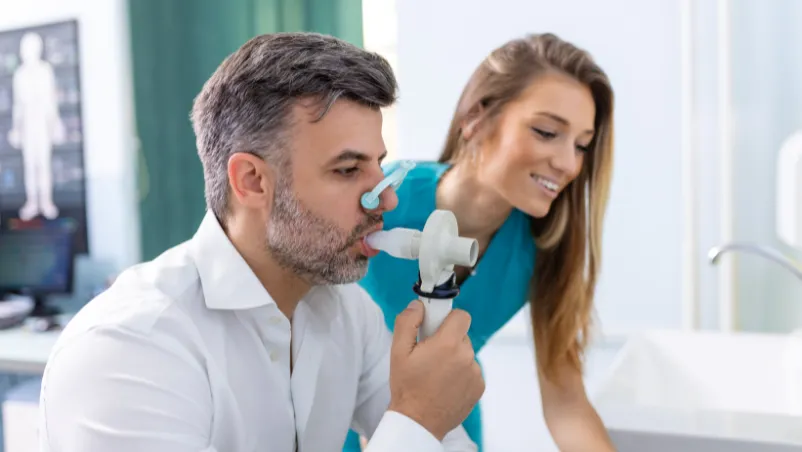
The test involves breathing into a mouthpiece connected to a machine that records airflow and volume; it is painless and non-invasive.
- The Spirometry Step
You’ll be asked to take the deepest breath possible, then blow out as hard and fast as you can, almost like blowing out birthday candles. This is repeated a few times for consistency.
- The Bronchodilator Step
In many cases, you’ll inhale a bronchodilator (a medicine that opens the airways) and repeat the test. Comparing before-and-after results tells doctors whether airway narrowing is reversible, which is key in diagnosing asthma versus COPD.
- Preparing Beforehand
Avoiding a heavy meal, skipping smoking for several hours prior, and following your doctor’s instructions about temporarily pausing inhalers all directly affect how accurate your results will be.
What Do Your PFT Results Actually Tell You?
Your results are compared to predicted “normal” values based on your age, height, sex, and ethnicity, rather than a single fixed number for everyone.
- Understanding FEV1 and FVC
FEV1 measures how much air you can force out in one second, while FVC measures the total air you can exhale. The ratio between them helps identify whether your airways are narrowed (obstructive pattern) or your lung expansion is limited (restrictive pattern).
- What the DLCO Number Reveals
This measurement reflects how efficiently oxygen crosses from your lungs into your bloodstream, and it’s especially useful for detecting diseases affecting lung tissue itself, rather than just the airways.
- Why One Test Rarely Gives the Full Answer
A single abnormal number rarely confirms a diagnosis alone: your doctor interprets the entire pattern together with your symptoms and history.
If you’ve noticed unexplained breathlessness or been advised to get your lung function checked, our Department of Pulmonology at Shenoy Hospitals, Secunderabad offers complete pulmonary function testing with same-day interpretation, so you leave with answers, not just a report.
What Happens After an Abnormal Result?
An abnormal PFT result leads to further evaluation, not immediate worry. It’s a starting point for diagnosis, not a diagnosis itself.
- Follow-Up Imaging and Tests
Depending on the pattern found, your doctor may recommend a chest X-ray, CT scan, or blood tests to pinpoint the exact cause.
- Building a Treatment Plan
Results directly shape treatment. For example, confirming reversible airway narrowing supports an asthma diagnosis and guides which inhaler therapy will help most.
If you’ve noticed unexplained breathlessness or been advised to get your lung function checked, our Department of Pulmonology at Shenoy Hospitals, Secunderabad, offers complete pulmonary function testing with same-day interpretation, so you leave with answers, not just a report. Our respiratory specialists guide you through every result in plain language.
How Does Breathlessness Affect Daily Life Before Diagnosis?
Unexplained breathlessness often affects confidence and daily routine long before a diagnosis is made.
- The Quiet Adjustment Pattern
Many patients unconsciously start avoiding stairs, slowing their pace, or skipping activities without realizing how much they’ve scaled back, until testing puts a name to what’s happening.
- The Relief of a Clear Answer
Even when results show a chronic condition, most patients describe genuine relief in finally understanding what’s causing their symptoms, rather than continuing to guess.
Can You Improve Your Lung Function After Testing?
Yes, depending on the cause, lung function can often be stabilized or improved with the right treatment and lifestyle changes.
- Medical Management
Inhaled medications, pulmonary rehabilitation programs, and, when appropriate, oxygen therapy can meaningfully improve day-to-day breathing capacity.
- Lifestyle Steps That Help
Quitting smoking, staying current with respiratory vaccinations, and gradually building exercise tolerance under medical guidance all support better long-term lung health.
Final Thoughts
A pulmonary function test can feel intimidating simply because it’s unfamiliar, but it’s one of the most useful, low-risk tools we have for understanding how your lungs are truly performing. Whether your results come back normal or reveal something that needs attention, you’ll walk away with clarity instead of uncertainty. And with the right follow-up care, most lung conditions identified through PFTs can be managed effectively.
FAQs
Is a pulmonary function test painful?
No, it involves only breathing through a mouthpiece and causes no pain, though some people feel briefly lightheaded from the forceful breathing.
How long does a PFT take?
Most complete pulmonary function tests take between 30 and 45 minutes, including preparation and repeat measurements.
Can I eat before a pulmonary function test?
You should avoid a heavy meal shortly before the test, as a full stomach can make deep breathing more difficult.
Do I need to stop my inhaler before the test?
Your doctor may ask you to pause certain inhalers for several hours beforehand, since this affects how the reversibility portion of the test is interpreted.
Can a PFT detect lung cancer directly?
Not directly, but abnormal results affecting airflow or gas exchange can prompt further imaging that may lead to a cancer diagnosis.
Is the PFT machine the same for adults and children?
Similar equipment is used, though the technique is adapted and results are compared against different reference ranges for children.
How often should someone with asthma repeat this test?
This depends on how well-controlled your asthma is, but many patients repeat testing every six to twelve months or after any major symptom change.
Can anxiety affect PFT results?
Yes, anxiety can cause shallow or irregular breathing during the test, so staying calm and following instructions carefully improves accuracy.
Will I get my results the same day?
Many pulmonary function tests can be interpreted the same day, though a formal written report may take a little longer depending on the facility.
Can lung function improve on its own without treatment?
Some causes, like temporary infections, resolve naturally, but chronic conditions typically need ongoing medical management to maintain or improve lung function.
Medical Disclaimer:
Content regarding Pulmonary Function Tests (PFTs), spirometry, and respiratory diagnostic measurements is for educational purposes only and not a substitute for clinical medical advice. Always consult a qualified pulmonologist for accurate test interpretation, preparation guidelines, and personalized lung health management.