
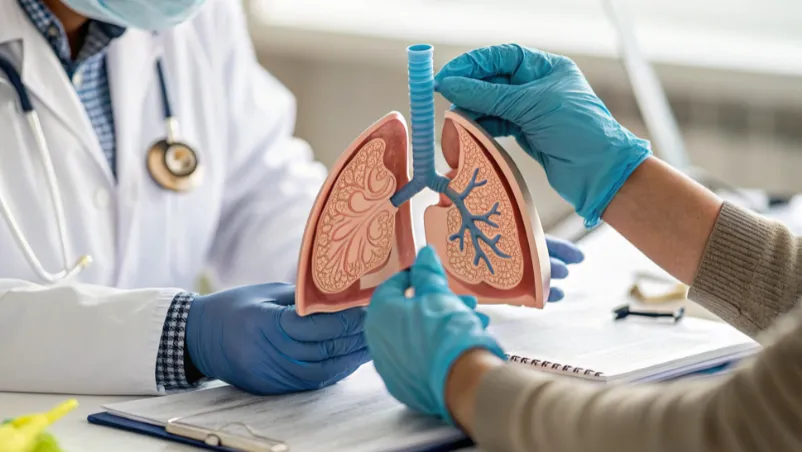
If you’re living with a persistent cough, mucus, wheezing, or breathlessness, getting the right assessment can make a real difference to how you manage your condition.
At Shenoy Hospitals, we provide personalised respiratory care for patients looking for COPD treatment in Secunderabad, based on symptoms, lung function, flare-ups, smoking or exposure history, and overall health.
Key Takeaways
- COPD is a long-term lung condition, but treatment can improve symptoms and daily function.
- Spirometry is an important test used to confirm COPD and assess airflow limitation.
- COPD treatment commonly includes inhalers, lifestyle measures, pulmonary rehabilitation, and other therapies when needed.
- COPD stage and treatment group are assessed using lung function, symptoms, and the history of flare-ups.
- Early specialist care can help reduce avoidable flare-ups and support better long-term breathing control.
Why Shenoy Hospitals
1963
Established Since 1963
Oldest nursing home
in Secunderabad
¼ Cost
corporate hospital bills
1L+
Babies Delivered
Successfully delivered
over 1 lakh babies
What Is COPD and Why Does It Make Breathing Difficult?
COPD, or chronic obstructive pulmonary disease, is a long-term condition that makes it harder for air to move out of the lungs.
It usually involves persistent narrowing of the airways and changes in the lung tissue. The result can be breathlessness, chronic cough, mucus production, wheezing, and reduced exercise capacity, a pattern also described by MedlinePlus, the U.S. National Library of Medicine’s COPD resource.
COPD includes conditions such as chronic bronchitis and emphysema. Some people have mainly airway symptoms, while others have more changes in the lung tissue.
COPD doesn’t mean that you have to stop doing the activities you enjoy. The aim of treatment is to help you breathe better, remain active, and reduce flare-ups.
What Causes COPD and Who Is More Likely to Develop It?
Long-term exposure to cigarette smoke is a major risk factor for COPD, but smoking isn’t the only possible cause.
Other risk factors can include:
- Second-hand smoke
- Indoor and outdoor air pollution
- Dust, fumes, and chemicals at work
- Biomass fuel exposure
- Repeated respiratory problems
- Certain genetic conditions, such as alpha-1 antitrypsin deficiency
People who have never smoked can also develop COPD, particularly when they have had long-term exposure to smoke, pollution, occupational dust, or other lung irritants.
Your doctor may ask about your work environment, cooking fuel, smoking history, previous lung infections, and family history.
When Does COPD Start and How Serious Can It Become?
COPD can develop gradually, and many people don’t recognise the early symptoms because breathlessness may initially appear only during physical activity.
You might first notice that you get tired while walking, climbing stairs, exercising, or doing household work.
As airflow limitation and disease burden increase, symptoms may become more noticeable and flare-ups may occur.
- What Do COPD Stages 1 to 4 Mean?
The traditional GOLD spirometric grades range from 1 to 4 and are based mainly on the amount of airflow limitation measured after bronchodilator use.
In simple terms:
- GOLD 1: Mild airflow limitation
- GOLD 2: Moderate airflow limitation
- GOLD 3: Severe airflow limitation
- GOLD 4: Very severe airflow limitation
These numbers don’t tell the whole story.
Current COPD assessment also considers symptom burden and exacerbations, or flare-ups, when placing patients into treatment groups.
This means two people with similar spirometry results may not need exactly the same treatment.
How Is COPD Diagnosed?
COPD is diagnosed using your symptoms, medical history, exposure history, examination, and lung function testing.
The most important test is spirometry, also called a lung function test.
During spirometry, you’ll take a deep breath and blow forcefully into a device called a spirometer. It measures how much air you can exhale and how quickly you can do it.
For a fuller explanation of what this and related breathing tests actually measure, see what a pulmonary function test measures.
Depending on your symptoms, your doctor may also recommend:
- Chest X-ray
- CT scan when clinically indicated
- Oxygen level assessment
- Additional lung function testing
- Blood tests in selected cases
- Assessment for other causes of breathlessness
A cough or breathlessness alone doesn’t confirm COPD. Proper testing helps distinguish COPD from asthma, heart conditions, infections, bronchiectasis, and other respiratory problems, a distinction we’ve explored in more depth in how doctors actually tell asthma and COPD apart.
Which COPD Inhalers Are Used for Treatment?
Inhalers are a major part of COPD treatment because they deliver medicine directly into the lungs.
The medicines used most often include bronchodilators, which relax the muscles around the airways and make it easier for air to move.
Depending on your symptoms and flare-up history, treatment may involve:
- Short-Acting Bronchodilators
Short-acting inhalers can provide quick relief when symptoms occur.
They may be prescribed for people who have occasional symptoms or as part of an individual treatment plan.
The exact medicine and frequency should be decided by your doctor.
- Long-Acting Bronchodilators
Long-acting inhalers provide more sustained airway opening and are commonly used for regular COPD symptoms.
They may contain a long-acting beta-2 agonist, known as a LABA, or a long-acting muscarinic antagonist, known as a LAMA.
Some patients may benefit from a combination of both.
- Inhaled Corticosteroids
Inhaled corticosteroids aren’t automatically required for every person with COPD.
They may be considered for selected patients, particularly when there is a history of exacerbations and clinical features suggesting they may benefit.
Your doctor may also consider blood eosinophil levels and whether you have features of asthma when deciding whether an inhaled corticosteroid is appropriate.
- Triple Inhaler Therapy
Some patients with persistent symptoms or repeated exacerbations may need combination therapy involving a LAMA, LABA, and inhaled corticosteroid.
Triple therapy isn’t simply a “stronger inhaler” that everyone with advanced COPD needs.
The choice should be based on your symptoms, exacerbation history, response to treatment, and other clinical factors.
How Do You Know Which Inhaler Is Right for You?
There isn’t one best inhaler for every person with COPD.
Your pulmonologist may consider:
- Your level of breathlessness
- Frequency of flare-ups
- Lung function
- Other medical conditions
- Previous response to inhalers
- Your ability to use a particular inhaler device
- Your ability to follow the prescribed schedule
The correct inhaler used incorrectly may not deliver the expected benefit.
That’s why we check inhaler technique during follow-up and make sure patients understand how and when to use their prescribed device.
Is a Nebulizer Better Than an Inhaler for COPD?
A nebulizer isn’t automatically better than an inhaler.
A nebulizer converts liquid medicine into a mist that can be inhaled through a mask or mouthpiece.
It may be useful in selected patients, particularly when symptoms are severe or when a patient has difficulty using an inhaler properly.
The choice between an inhaler and nebulisation should be based on your condition, medicine, breathing ability, and ability to use the device correctly.
We’ve compared the two devices directly, including which tends to act faster, in inhaler or nebulizer, which works faster.
What Other Treatments Can Help Control COPD?
COPD care isn’t limited to medicines. A complete treatment plan may include several approaches depending on your condition.
- Pulmonary Rehabilitation
Pulmonary rehabilitation combines supervised exercise, breathing techniques, education, and lifestyle support.
It can help suitable patients improve exercise capacity, reduce the impact of breathlessness, and feel more confident during daily activities.
- Oxygen Therapy
Long-term oxygen therapy may be recommended for selected patients who have persistently low oxygen levels.
It isn’t prescribed simply because someone has COPD or feels breathless.
Your oxygen level and overall clinical condition need to be assessed before oxygen therapy is recommended.
- Vaccination and Infection Prevention
Respiratory infections can trigger COPD flare-ups, so infection prevention is an important part of long-term care.
Your doctor can advise which vaccinations are appropriate for your age, medical history, and risk factors.
- Physical Activity
Regular physical activity is encouraged for most people with stable COPD, within their individual limits.
Avoiding activity completely can lead to muscle weakness and lower exercise tolerance, which may make everyday breathing feel harder.
What Is a COPD Exacerbation or Flare-Up?
A COPD exacerbation is a period when your usual breathing symptoms become worse than normal and require additional treatment.
You may notice:
- More breathlessness than usual
- Increased coughing
- More mucus
- A change in mucus colour
- Wheezing
- Reduced ability to perform normal activities
Infections, air pollution, smoke, and other triggers can contribute to flare-ups.
Don’t wait for symptoms to become severe before contacting your doctor when your usual COPD symptoms suddenly worsen.
What Should You Do During a Severe COPD Flare-Up?
Severe breathing difficulty requires urgent medical attention.
Seek emergency care if you have severe breathlessness, difficulty speaking because of breathing problems, bluish or grey lips, confusion, unusual drowsiness, or symptoms that aren’t responding to your prescribed treatment.
Don’t try to manage severe breathing difficulty at home without medical assessment.
At Shenoy Hospitals, our respiratory team provides specialist evaluation and treatment for COPD and other lung conditions.
Can COPD Be Controlled Even Though It Is a Long-Term Condition?
Yes, COPD can often be managed with an appropriate treatment plan, regular follow-up, and lifestyle changes.
Treatment can’t simply reverse established lung damage, but it can help control symptoms, improve activity levels, reduce exacerbations, and support quality of life.
Your treatment may also need adjustment over time.
COPD care is an ongoing process rather than a one-time prescription.
Does Smoking Cessation Still Help After COPD Is Diagnosed?
Yes, stopping smoking is beneficial even after COPD has already been diagnosed.
Continuing to smoke exposes the lungs to further irritation, while quitting removes an important ongoing source of lung damage.
If you smoke, speak openly with your doctor about stopping. You don’t have to handle smoking cessation alone.
Avoiding second-hand smoke is also important.
How Does COPD Affect Everyday Life and Emotional Health?
COPD can affect much more than breathing.
Breathlessness may make people avoid walking, travelling, exercising, social activities, or even simple household tasks.
Some patients also become anxious because they worry about becoming breathless in public.
This can create a cycle where fear of breathlessness leads to less activity, and less activity leads to poorer physical fitness.
A structured treatment plan, pulmonary rehabilitation, breathing techniques, and appropriate physical activity can help break this cycle.
Tell your doctor if COPD is affecting your sleep, work, relationships, confidence, or emotional wellbeing.
When Should You See a Pulmonologist for COPD?
You should see a pulmonologist if you have persistent breathlessness, a long-standing cough, repeated chest infections, regular mucus production, or symptoms that are gradually getting worse.
Specialist assessment is also important if:
- Your current inhaler isn’t controlling symptoms
- You have repeated COPD flare-ups
- You need frequent emergency treatment
- Your exercise ability is decreasing
- You have unexplained low oxygen levels
- Another lung condition may be present
At Shenoy Hospitals, our Pulmonology Department provides respiratory care for COPD, asthma, interstitial lung disease, sleep disorders, pulmonary infections, and other lung conditions.
If any of these apply to you, that’s your signal to get a specialist assessment rather than adjusting your inhaler use on your own. Our Pulmonology Department at Shenoy Hospitals, including Dr. V. Dinesh Reddy, Dr. M. Sravya Reddy, and Dr. Tapaswi Krishna, can help. Book an Appointment.
Can COPD Treatment Prevent the Condition From Getting Worse?
Treatment can help reduce symptoms, lower the risk of exacerbations, and support better long-term lung health, but established lung damage cannot simply be reversed.
The most useful steps include:
- Stopping smoking
- Taking prescribed medicines correctly
- Using inhalers with the correct technique
- Staying physically active as advised
- Attending follow-up appointments
- Avoiding known lung irritants
- Following vaccination advice
- Completing pulmonary rehabilitation when recommended
The earlier persistent symptoms are assessed, the sooner an appropriate management plan can begin.
Why Choose Shenoy Hospitals for COPD Care?
Our approach to COPD care focuses on accurate assessment, personalised treatment, and helping patients manage their breathing in everyday life.
Our Pulmonology Department at Shenoy Hospitals provides pulmonary function testing, COPD management, inhaler guidance, bronchoscopy, and other respiratory services based on individual clinical needs.
Our specialists also manage other respiratory conditions that can sometimes resemble COPD, helping us assess the bigger picture rather than treating breathlessness in isolation.
- Get Specialist COPD Care at Shenoy Hospitals
If persistent cough, mucus, breathlessness, or repeated chest problems are affecting your daily life, our Pulmonology Department at Shenoy Hospitals, East Marredpally, Secunderabad, can assess your symptoms and guide you toward an appropriate COPD management plan. Our respiratory specialists can help with diagnosis, inhaler optimisation, pulmonary assessment, and long-term COPD care.
FAQs About COPD Treatment
Can someone have COPD even if they never smoked?
Yes, COPD can occur in people who have never smoked. Long-term exposure to air pollution, biomass smoke, occupational dust or fumes, and certain genetic conditions can contribute.
Can COPD cause weight loss?
Yes, advanced COPD can sometimes be associated with unintentional weight loss and muscle loss. If you’re losing weight without trying, tell your doctor because other causes may also need to be considered.
Can COPD affect sleep?
Yes, COPD can interfere with sleep because of coughing, mucus, breathlessness, or coexisting sleep-related breathing problems. Tell your doctor if you regularly wake up breathless or feel unusually tired during the day.
Can COPD patients travel by air?
Yes, many people with stable COPD can travel by air, but those with significant breathlessness or low oxygen levels may need assessment before flying. Your doctor can advise whether oxygen or other precautions are required.
Can cold weather make COPD symptoms worse?
Yes, cold air can worsen breathing symptoms in some people with COPD. Covering your nose and mouth and avoiding sudden exposure to very cold air may help reduce discomfort.
Can COPD cause headaches in the morning?
Yes, morning headaches can occur in some people with advanced breathing problems, particularly when carbon dioxide levels rise during sleep. Repeated morning headaches should be discussed with a doctor rather than assumed to be caused by COPD.
Is chest physiotherapy useful for COPD?
Yes, selected patients may benefit from breathing exercises and airway-clearance techniques, particularly when mucus is difficult to clear. A respiratory professional can advise which technique is appropriate.
Can COPD patients eat normally?
Yes, most people with COPD can eat a normal balanced diet, although severe disease may make large meals uncomfortable because a full stomach can increase the feeling of breathlessness. Smaller meals may be easier for some patients.
Can COPD cause swelling in the legs?
Yes, leg or ankle swelling can occur in some people with advanced COPD, but it can also result from heart, kidney, liver, medication, or circulation problems. New or persistent swelling needs medical assessment.
Can COPD be confused with heart disease?
Yes, COPD and heart disease can cause similar symptoms such as breathlessness and reduced exercise tolerance. A proper medical assessment helps identify whether the symptoms are coming from the lungs, heart, or both.
Final Thoughts
COPD is a long-term condition, but it doesn’t mean you have to give up your normal life.
The right diagnosis, appropriate inhaler treatment, smoking cessation, physical activity, pulmonary rehabilitation, and regular follow-up can help you manage symptoms and reduce the impact of flare-ups.
If your breathing has gradually become harder, don’t dismiss it as normal ageing. A proper respiratory assessment can help identify the cause and guide the right treatment.
Medical Disclaimer:
Content regarding COPD stages, spirometry, LAMA/LABA inhalers, and acute flare-up care is for educational purposes only and not a substitute for clinical medical advice. Always consult a qualified pulmonologist or healthcare professional for accurate diagnosis and personalized treatment planning.