Seeing your newborn under blue lights can be frightening, especially when you don’t know how long treatment will take or what it will cost.
At Shenoy Hospitals, we assess the baby’s age, bilirubin level, gestational age, feeding, and other risk factors before deciding whether phototherapy is needed.
Key Takeaways
- Phototherapy is a common and effective treatment for significant newborn jaundice.
- Treatment duration varies, but many babies need around 1 to 2 days of phototherapy.
- The decision to start phototherapy depends on bilirubin level, baby’s age in hours, gestational age, and risk factors.
- Breastfeeding usually continues during phototherapy, with feeding support when needed.
- At Shenoy Hospitals, phototherapy is currently listed at ₹1,500 to ₹2,500 per day, while the total cost depends on the baby’s care needs.
Why Shenoy Hospitals
1963
Established Since 1963
Oldest nursing home
in Secunderabad
¼ Cost
corporate hospital bills
1L+
Babies Delivered
Successfully delivered
over 1 lakh babies
What Is Newborn Jaundice and Why Does It Happen?
Newborn jaundice happens when bilirubin builds up in a baby’s blood, causing the skin and whites of the eyes to look yellow.
Bilirubin is produced when red blood cells break down. A newborn’s liver may not yet be mature enough to remove bilirubin quickly.
Mild jaundice is common in newborns and often improves as feeding becomes established and the baby’s liver becomes more efficient.
The concern is when bilirubin rises to a level that requires treatment or when jaundice appears unusually early or is linked to another medical problem.
When Does a Newborn Need Phototherapy?
A baby needs phototherapy when the bilirubin level reaches the treatment threshold appropriate for the baby’s age, gestational age, and risk factors.
Doctors don’t decide treatment from the bilirubin number alone.
We consider:
- Baby’s age in hours
- Gestational age at birth
- Total serum bilirubin level
- Rate at which bilirubin is rising
- Blood group incompatibility or suspected red blood cell breakdown
- Sepsis or other medical instability
- Previous need for phototherapy
Current American Academy of Pediatrics guidance recommends using the total serum bilirubin level along with the baby’s age in hours, gestational age, and neurotoxicity risk factors when deciding whether phototherapy is required.
This is why the same bilirubin value may require treatment in one newborn but monitoring in another.
How Does Phototherapy Treat Newborn Jaundice?
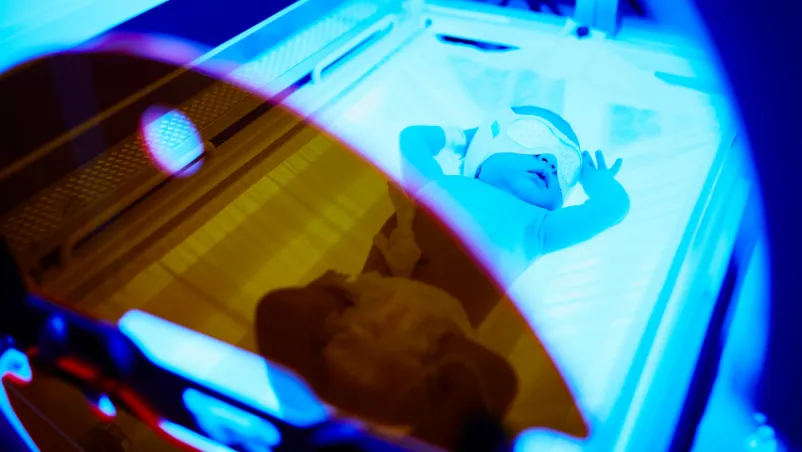
Phototherapy uses a special blue light to change bilirubin into forms that the baby’s body can remove more easily.
The baby is placed under an appropriate phototherapy light, with as much skin exposed to the light as safely possible.
The eyes are protected according to the equipment and clinical protocol.
Phototherapy doesn’t remove blood from the baby or involve an injection into the baby. It is a non-invasive treatment.
Modern intensive phototherapy commonly uses narrow-spectrum LED blue light with appropriate irradiance and adequate skin exposure.
What Happens During the Phototherapy Process?
During phototherapy, your baby stays under the prescribed light while the neonatal team monitors bilirubin levels, feeding, temperature, hydration, and overall condition.
The process usually involves:
- Bilirubin assessment: We check the baby’s bilirubin level and determine whether treatment is required.
- Phototherapy: The baby is positioned under the appropriate light source with eye protection and genital protection.
- Feeding: Breastfeeding or expressed breast milk is continued whenever possible.
- Monitoring: Bilirubin and the baby’s clinical condition are checked during treatment.
- Stopping treatment: Phototherapy is stopped when the bilirubin level has fallen sufficiently and the baby’s doctor considers it safe.
The exact process can differ for premature babies, babies with blood-group incompatibility, babies with infection, or newborns with rapidly rising bilirubin.
How Long Does Phototherapy Take for Newborn Jaundice?
Many newborns need phototherapy for about 24 to 48 hours, but there is no fixed treatment duration for every baby.
The duration depends on:
- Starting bilirubin level
- Baby’s age and gestational age
- Cause of jaundice
- Speed at which bilirubin falls
- Whether there are risk factors for bilirubin-related complications
- Whether bilirubin rises again after treatment
Some babies may need a shorter period, while others may require longer or more intensive treatment.
We don’t stop phototherapy simply because a certain number of hours has passed. We use the baby’s bilirubin response and clinical condition to guide the decision.
How Is Bilirubin Checked During Phototherapy?
Serum bilirubin testing is used to guide treatment decisions and monitor how the baby is responding.
The timing of repeat testing depends on the baby’s age, bilirubin level, risk factors, and how the bilirubin changes after treatment starts.
For hospitalised newborns receiving phototherapy, the AAP recommends checking total serum bilirubin within 12 hours of starting treatment, with the exact timing guided by the baby’s individual situation.
Parents shouldn’t be alarmed if the doctor orders repeated bilirubin tests. Monitoring is an important part of safe phototherapy.
Can I Breastfeed My Baby During Phototherapy?
Yes, breastfeeding usually continues during phototherapy.
Feeding helps provide hydration and supports bilirubin removal through urine and stool.
Depending on the baby’s condition, we may advise frequent breastfeeding, expressed breast milk, or additional supplementation when medically appropriate.
Don’t stop breastfeeding simply because your baby is receiving phototherapy unless your neonatal team gives you a specific reason to do so.
The AAP recommends maintaining feeding during phototherapy and minimising interruptions when bilirubin is approaching levels requiring escalation of care.
Is Phototherapy Safe for Newborns?
Phototherapy is widely used and is considered a safe treatment when properly administered and monitored.
Some babies may develop loose stools, mild skin changes, increased fluid needs, or temperature changes during treatment, effects also described by MedlinePlus, the U.S. National Library of Medicine’s newborn jaundice discharge guidance. The neonatal team monitors the baby to identify problems early.
The neonatal team monitors the baby to identify problems early.
The benefits of phototherapy outweigh its potential risks when bilirubin has reached the recommended treatment threshold.
Can Sunlight Replace Phototherapy?
No, parents shouldn’t use direct sunlight as a substitute for medical phototherapy.
Sunlight exposure isn’t a reliable or controlled way to deliver the correct light intensity and spectrum to a newborn.
The AAP specifically does not recommend sunlight as a reliable treatment for neonatal hyperbilirubinemia.
If your baby’s bilirubin is high enough to require treatment, use the treatment recommended by your baby’s doctor rather than trying home sunlight exposure.
What Is the Newborn Jaundice Phototherapy Cost in secunderabad?
At Shenoy Hospitals, the currently listed phototherapy charge is approximately ₹1,500 to ₹2,500 per day.
The hospital’s neonatal-care information also lists NICU bed charges at approximately ₹3,000 to ₹7,000 per day.
The final bill can vary depending on:
- Number of days of phototherapy
- NICU or newborn-care requirement
- Bilirubin tests
- Neonatologist or paediatric consultation
- Feeding or hydration support
- Additional investigations
- Treatment for an underlying cause
If your baby also needs broader NICU support, our separate breakdown of NICU care costs for a premature baby covers what that adds to the total.
A baby who needs simple phototherapy may have a different total cost from a premature or medically unstable newborn requiring additional NICU care.
At Shenoy Hospitals, we recommend asking our team for an individual estimate based on your baby’s clinical needs rather than relying on a fixed online package price.
What Can Make Phototherapy Take Longer?
Phototherapy may take longer when bilirubin is rising quickly, the starting level is high, or an underlying cause continues to increase bilirubin.
Possible reasons include:
- Blood group incompatibility
- Increased breakdown of red blood cells
- G6PD deficiency
- Infection
- Prematurity
- Poor feeding or dehydration
- Other medical conditions affecting bilirubin processing
In more significant cases of hemolysis, a baby may need additional intervention beyond phototherapy alone, including a newborn blood transfusion in the NICU, which we’ve covered separately.
If bilirubin doesn’t fall as expected, we don’t simply continue the light without looking for the reason. The baby may need additional tests and a change in treatment.
The AAP recommends investigating the cause of significant hyperbilirubinemia in infants who require phototherapy, including assessment for hemolysis in appropriate situations.
What Happens After Phototherapy Is Stopped?
Some babies need a follow-up bilirubin check after phototherapy because bilirubin can rise again, which is called rebound hyperbilirubinemia.
The risk isn’t the same for every newborn.
Closer follow-up may be needed when phototherapy was started early, when there is suspected or confirmed hemolysis, or when certain other risk factors are present.
Stopping the light doesn’t always mean the baby’s bilirubin will never rise again, so follow-up advice should be followed carefully.
The AAP recommends post-phototherapy bilirubin measurement based on the baby’s risk of rebound hyperbilirubinemia.
When Is Newborn Jaundice More Concerning?
Jaundice needs prompt medical assessment when it appears during the first 24 hours of life, becomes deeper or spreads quickly, or occurs along with poor feeding or unusual behaviour.
Parents should contact a doctor promptly if the baby:
- Is difficult to wake for feeding
- Isn’t feeding well
- Becomes unusually sleepy or difficult to arouse
- Has worsening yellow discoloration
- Has fever or appears unwell
- Has dark urine or unusually pale stools
- Develops jaundice very early after birth
Jaundice appearing within the first 24 hours deserves particular attention because it can be associated with increased red blood cell breakdown or another underlying problem.
Can Newborn Jaundice Be Prevented?
Not every case of newborn jaundice can be prevented, but good feeding and appropriate monitoring can reduce the risk of bilirubin becoming excessively high.
Useful steps include:
- Start feeding as advised after birth
- Feed frequently according to your baby’s needs
- Watch for signs of poor feeding or dehydration
- Attend recommended newborn check-ups
- Complete bilirubin screening when advised
- Follow up promptly if your baby’s jaundice is increasing
Don’t wait for the yellow colour to become severe before seeking medical advice.
Why Choose Shenoy Hospitals for Newborn Jaundice Care?
Newborn jaundice sometimes needs simple observation, while other babies require phototherapy and closer neonatal monitoring.
At Shenoy Hospitals, our neonatal care team provides assessment and treatment for newborns who need specialised care, including phototherapy, NICU care, and feeding support.
Our neonatal services include phototherapy, NICU care, feeding support, monitoring, and care for babies who need a higher level of medical attention.
Our approach is to treat the bilirubin level while also looking at why the jaundice developed and whether the baby needs further monitoring.
Get Newborn Jaundice Care at Shenoy Hospitals
If your baby’s bilirubin level is rising or your pediatrician has recommended phototherapy, our Neonatal and Paediatric Department at Shenoy Hospitals, East Marredpally, Secunderabad, can assess your baby and guide you through the treatment process. Our team can explain the bilirubin results, phototherapy requirement, expected duration, monitoring, and likely care costs for your baby’s individual situation.
At Shenoy Hospitals, we recommend asking our team for an individual estimate based on your baby’s clinical needs rather than relying on a fixed online package price. Call Now to discuss your baby’s specific situation.
FAQs About Newborn Jaundice Phototherapy
- Will my baby feel pain during phototherapy?
No, phototherapy itself isn’t painful. Your baby may need frequent handling for feeding, bilirubin testing, and monitoring, but the light treatment itself shouldn’t cause pain.
- Can my baby wear clothes during phototherapy?
Usually, the baby needs as much skin exposed to the therapeutic light as safely possible. The neonatal team will decide what clothing or covering is appropriate while protecting the baby’s eyes and maintaining body temperature.
- Will phototherapy make my baby dehydrated?
Phototherapy can increase fluid requirements in some babies, so feeding and hydration are monitored. Your neonatal team may recommend more frequent feeds or additional support if needed.
- Can jaundice return after my baby comes home?
Yes, bilirubin can rise again after treatment in some babies. Follow-up testing is recommended when the baby’s doctor considers the risk of rebound jaundice significant.
- Does blood group incompatibility cause newborn jaundice?
Yes, blood group incompatibility can cause increased breakdown of the baby’s red blood cells and lead to higher bilirubin. Babies with suspected hemolysis may need closer monitoring and additional testing.
- Does a premature baby need phototherapy at a lower bilirubin level?
Yes, premature or younger-gestational-age babies may have lower treatment thresholds. Doctors consider gestational age and other risk factors when deciding whether phototherapy is needed, similar to the considerations we’ve laid out in what to expect with a 34-week premature baby in the NICU.
- Can a baby have phototherapy at home?
Home phototherapy may be an option for carefully selected babies under medical supervision. It requires an appropriate device, reliable bilirubin monitoring, and a baby who meets specific clinical criteria.
- Does phototherapy affect breastfeeding?
No, phototherapy doesn’t mean breastfeeding has to stop. Feeding is generally continued, with expressed milk or other supplementation considered when the baby’s intake is inadequate.
- Why does my baby need another bilirubin test after phototherapy?
The repeat test checks whether bilirubin is rising again after treatment. This helps the doctor identify rebound hyperbilirubinemia and decide whether further monitoring or treatment is required.
- Can newborn jaundice be caused by something other than normal newborn changes?
Yes, some cases are linked to blood group incompatibility, red blood cell disorders, infection, feeding problems, or other medical conditions. When jaundice is unusually early, severe, prolonged, or not responding as expected, doctors investigate the underlying cause.
Final Thoughts
Newborn jaundice is common, and phototherapy is an established treatment when bilirubin reaches the appropriate treatment threshold.
The treatment may last a day, two days, or longer depending on the baby’s bilirubin level, age, gestational age, cause of jaundice, and response to treatment.
What matters most isn’t the number of hours under the light or the cost alone. It’s making sure your baby receives the right treatment at the right time with proper bilirubin monitoring and follow-up.
Medical Disclaimer:
This article is for general health information and doesn’t replace an examination or medical advice from a paediatrician or neonatologist. Phototherapy decisions for newborn jaundice must be based on the baby’s clinical condition, age in hours, gestational age, bilirubin level, and individual risk factors. If your newborn develops worsening jaundice, poor feeding, unusual sleepiness, fever, or other concerning symptoms, seek prompt medical evaluation.